Aug 18, 2026
Dubai's Infrastructure Boom: Why 2026 Is a Pivotal Year for Investors
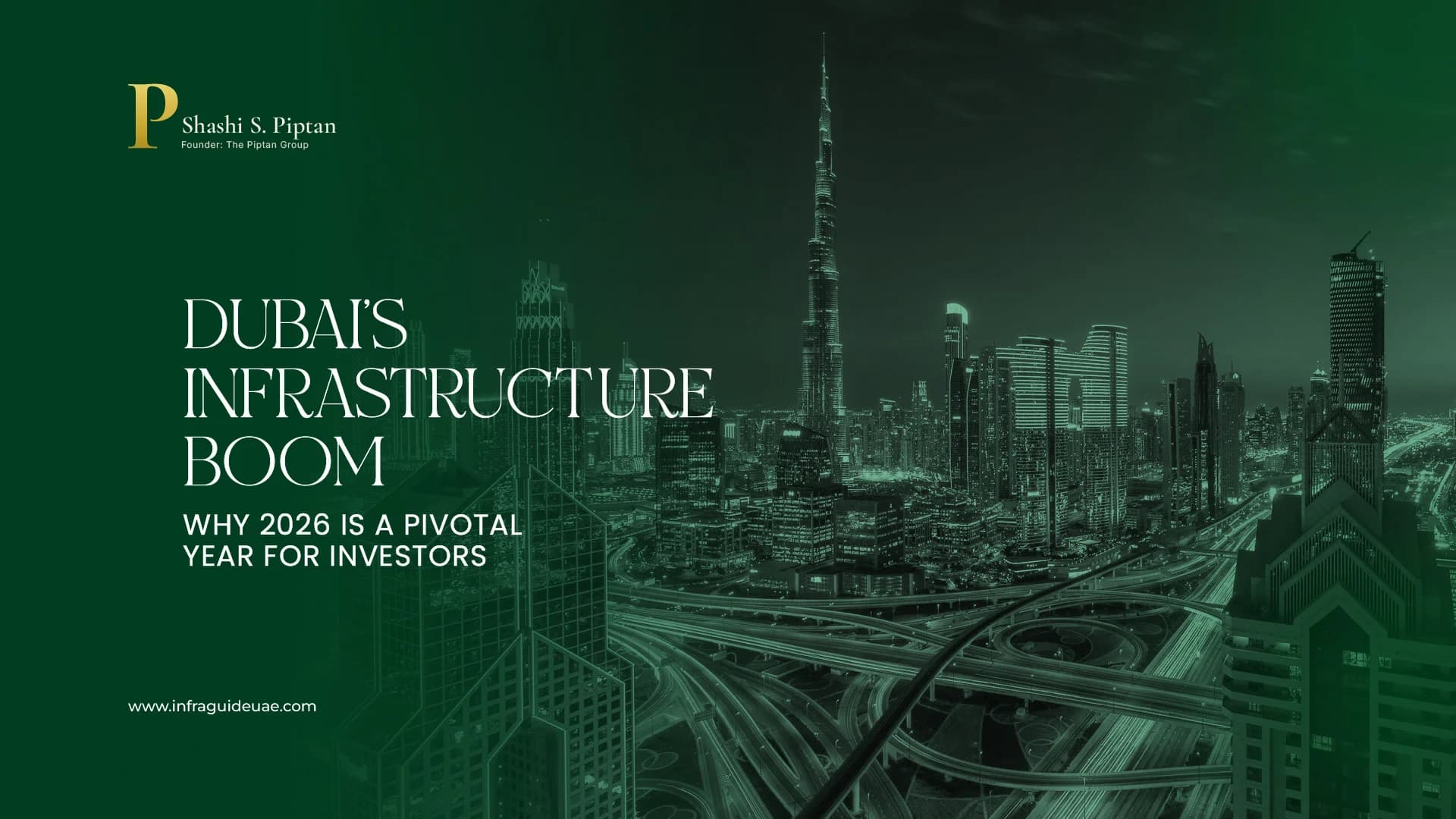
Picture Dubai just 66 years ago: a small port town of about 40,000 people. Today, it's home to 3.3 million residents, and its built-up area has grown a staggering 170 times over. That kind of growth doesn't just happen and then stop. In fact, 2026 is turning out to be one of the most exciting years yet if you're keeping an eye on Dubai as a place to invest.
A whole new wave of transport, energy, and urban development projects is moving from paper to pavement, and the rules around how money flows into these projects are getting clearer and more investor-friendly along the way.
So if you're an investor, urban planner, or advisor watching the UAE market, this is a good moment to understand where all this growth is happening and why it matters to you.
The Blueprint Behind It All: Dubai 2040 Urban Master Plan
Almost everything being built right now ties back to one document: the Dubai 2040 Urban Master Plan. Think of it as the emirate's long-term roadmap for tying together land use, transportation, and everyday quality of life. Here's what it's aiming for over the next two decades:
- Doubling the amount of green and recreational space, with nature reserves eventually covering 60% of the emirate.
- Growing public beachfront length by a huge 400%.
- Expanding commercial land to 168 square kilometres, plus a 134% increase in hotel and tourism land.
- Upgrading five major urban centres (Deira and Bur Dubai, Downtown and Business Bay, and Dubai Marina and JBR), along with two brand-new hubs at Expo City and Dubai Silicon Oasis.
- Making it easier to get around by leaning into mass transit, walking, and cycling, all connected through green corridors linking homes, workplaces, and everyday services.
Once you see this bigger picture, individual projects start to make a lot more sense. A new metro line or a drainage upgrade isn't just a random headline. It's one piece of a much larger, carefully planned puzzle, which is exactly why this plan is so useful if you're trying to figure out where value is likely to grow next.
The Projects Bringing the Plan to Life
2026 is shaping up to be a milestone year, with several major projects reaching key construction or launch stages:
| Project | Sector | Scale / Timeline |
|---|---|---|
| Al Maktoum International Airport Expansion | Aviation | ~AED 128 billion; Phase 1 operational by 2032 |
| Etihad Rail | National Railway | 900 km network; passenger services launching in 2026 |
| Dubai Metro Blue Line | Urban Transit | AED 20.5 billion; 30 km, 14 stations; targeted 2029 |
| Mohammed bin Rashid Al Maktoum Solar Park | Renewable Energy | 8,000+ MW targeted by 2030; Phase 6 complete Q4 2026 |
| Dubai Financial Centre Expansion | Commercial / Urban | AED 100 billion; 17.7 million sq ft |
| Tasreef Program Phase 2 | Stormwater Infrastructure | AED 2.5 billion across 30 areas |
Alongside these headline-grabbing projects, there's a lot of quieter but equally important work happening behind the scenes.
This includes hundreds of millions of dirhams going into stormwater and drainage upgrades (like the Al Quoz and Deira drainage projects), new roads and bridges across the northern emirates, and a Dh1 billion programme to make government buildings more energy-efficient across 360 facilities.
None of this makes headlines the way a new airport does, but it's exactly what makes the bigger projects actually livable, and worth investing in.
Why All of This Matters If You're Investing
Here's the thing: infrastructure spending doesn't just build roads and rail lines. It quietly redraws the entire investment map. A few trends worth keeping an eye on this year:
1. Connectivity is quickly becoming the biggest value driver
As the Metro Blue Line, Etihad Rail, and new highways come online, neighbourhoods that once felt out of the way are being pulled right into Dubai's economic core. Being close to good transit has always been one of the strongest signs that property values are about to rise, and that pattern doesn't look like it's slowing down anytime soon.
2. It's not just about real estate anymore
The current pipeline of projects leans heavily into renewable energy (the Al Maktoum Solar Park is aiming for over 8,000 MW), logistics and industrial zones (thanks to KEZAD's expansion), and aviation (the AED 128 billion Al Maktoum International Airport expansion).
If you're only looking at residential and commercial real estate, you might be missing the sectors the government itself is betting the most on.
3. The rules are getting friendlier, not more complicated
As Dubai's infrastructure ambitions have grown, so has the sophistication of the legal and regulatory frameworks around foreign investment, land ownership, and public-private partnerships. Understanding these frameworks, and not just the shiny new projects, is really what separates a well-informed investor from someone just chasing headlines.
Looking Ahead
Dubai's journey from a small port city to a global infrastructure hub didn't happen by chance, and its next chapter won't either.
The projects breaking ground in 2026 are proof of a much longer-term strategy, one that rewards the investors who take the time to understand the bigger blueprint, not just the individual headlines.
That's exactly the gap Infraguide UAE wants to help close. Our upcoming book, The Urban Evolution of Dubai: A Blueprint for Infrastructure Investment by Shashi S. Piptan, brings together market analysis, regulatory guidance, and real case studies to help investors and advisors navigate this kind of growth with confidence and clarity.
Want to stay in the loop?
Sign up on infraguideuae.com for early access, launch updates, and exclusive insights as the book gets closer to release.